Showing posts with label Acids and Bases. Show all posts
Showing posts with label Acids and Bases. Show all posts
Tuesday, February 16, 2016
"Mystery" Acid Lab
This lab was very similar to the titrations lab. We had to standardize a base (NaOH) then titrate a mystery acid (which turned out to be the aspirin we made earlier in the year) in order to determine its molar mass. We essentially had the same procedure as the titrations lab except we titrated the aspirin instead of the vinegar in this lab. The only problem that came up was that the mystery acid took a long time to dissolve in the water, so we spent a long time on waiting for the mystery to dissolve. Eventually, Frankenberg decided that we needed to put the acid solution on a hot plate to speed up the process, and that helped immensely.

Thursday, February 11, 2016
I Want To Die
Today's acid base test was awful. I guessed on about 5 questions and did not feel confident with half of my answers. The test itself had a lot of the same content that was on the practice resources, but some of the questions needed elevated thinking. Unlike the last quiz, I felt more confident with my definition-y answers because they were easier to process, and the math questions were all pretty long and complex. I am praying for a C.

Monday, February 8, 2016
Quiz Acids and Bases
 Taking this quiz, I felt OK. I can't really say I was confident because I felt so rushed the entire time since I had less time to finish the quiz than normal, but getting my grade back later that week, I felt like it reflected accurately my comprehension of the unit. It was not a good grade, to say the least, but it was only a quiz thankfully and now I have worked toward correcting these mistakes. I thought, going into the quiz, that I would be most tripped up by the ICE box and math problems, but I found that I was actually tripped up by the definition-y problems which makes sense since I didn't study that part of the material as much. I'm glad we've been doing long labs and low-stress activities in class because I have been able to go home and study for the test this Thursday. I'm glad that I've made these mistakes and am able to correct them, but I just have to pray that I don't make these silly mistakes on the test!
Sunday, February 7, 2016
Titrations!

 |
| The buret set-up |
 |
| Right before the color change |
 |
| The color change; it turns a nice light pink! |
Wednesday, February 3, 2016
Acids and Bases Run-Down
Basic Info:
Acids- feel sticky, taste sour, change litmus red, corrosive to metals, have a pH of 0-6.9
Bases- feel slippery, taste bitter, change litmus blue, have a pH of 7.1-14
Types:
There are two types of acids and bases that we are studying this unit: Arrhenius, and Bronsted-Lowry.
Arrhenius- Arrhenius acids form hydrogen ions in aqueous solution and Arrhenius bases form hydroxide ions (we learned about these a little in the Chemical Reactions unit)
Bronsted-Lowry- acid is defined as anything that releases H1+ ions; a base is defined as anything that accepts H1+ ions (this is new to this unit)
Acids- feel sticky, taste sour, change litmus red, corrosive to metals, have a pH of 0-6.9
Bases- feel slippery, taste bitter, change litmus blue, have a pH of 7.1-14
Types:
There are two types of acids and bases that we are studying this unit: Arrhenius, and Bronsted-Lowry.
Arrhenius- Arrhenius acids form hydrogen ions in aqueous solution and Arrhenius bases form hydroxide ions (we learned about these a little in the Chemical Reactions unit)
Arrhenius Video
Bronsted-Lowry- acid is defined as anything that releases H1+ ions; a base is defined as anything that accepts H1+ ions (this is new to this unit)
- Bronsted-Lowry acids and bases have conjugate acid and base pairs where the proton donors and acceptors are paired together
 |
| The CH3COOH is the proton donor and the CH3COO- is the proton acceptor |
Bronsted-Lowry Video
Acidic and Basic:
We can determine if a solution is acidic or basic by knowing its concentration of [H+] and [OH-]
- [H+]>[OH-] shows that the solution is acidic
- [H+]<[OH-] shows that the solution is basic
- Temperature does not affect [H+] or [OH-]
- Water can act as both acid or base so it is called amphoteric
Calculating pH, pOH, [H+] and [OH-]
There are a few formulas that help with calculating these values.
- If you are given the pH of a solution and you are trying to find the [H+] use the formula 10^-pH
- If you are given the [H+] and are trying to find the pH use the formula -log[H+]
- If you are given the pH and are trying to find the pOH use formula 14-pH
- If you are given the [H+] and are trying to get to [OH-] use the formula (1x10^-14)/[H+]
The rest of the calculations (like the inverses) are shown here in this cool flow chart.


Helpful Websites for this concept:
Kw and Equilibrium Constant
Kw is the equilibrium constant of water and is used as the equilibrium constant for reactions where
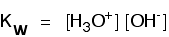
or
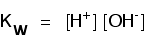
In water: Kw= [H+] [OH+] = 1.0x 10 ^-14
Helpful Websites for this concept:
Wednesday, January 27, 2016
Vitamin C Lab
This lab consisted of determining the vitamin C content of different juices. We got samples of pear, grapefruit, V8, and apple juices and compared these juices' vitamin C content to that of a standard solution. We used iodine as a indicator and dropped iodine into the juice samples until the juices turned blue. The grapefruit turned out to have the most vitamin C content, and the pear had the lowest vitamin C content.
 |
| Making the standard solution |
`
 |
| Lab set-up |
 |
| Adding drops of iodine to juice sample |
Subscribe to:
Posts (Atom)