
Showing posts with label Chemical Reactions. Show all posts
Showing posts with label Chemical Reactions. Show all posts
Thursday, December 3, 2015
Test Day ¡Yikes!

Wednesday, December 2, 2015
Metals Lab
The Metals Lab was fairly simple to complete. We had to place various aqueous solutions in small amounts of metals and record the reactions that took place. This lab was more interesting than the last in that some of the reactions bubbled, fizzed, and had gas come out. Overall, calcium turned out to be the most reactive metal, and lead was the least reactive.
 |
| The metals we worked with in the lab (zinc, lead, tin, magnesium, copper, calcium) |
 |
| The products of the reactions |
 |
| The products of the second round of reactions |
Monday, November 30, 2015
Redox Reactions
Redox reactions are the last reactions we will study in this unit. It encompasses synthesis, decomposition, and single replacement reactions. It is categorized by all reactions that involve in a transfer of electrons.
 |
- If the element/compound loses electrons, it is oxidized (because the charge becomes more positive)
- If the element/compound gains electrons it is reduced (because the charge becomes more negative)
Always Remember OIL RIG!!!
Oxidation Is Lost
Reduction Is Gained
OIL RIG
The "lost" and "gained" refers to the electrons
- Also, to make things more confusing, the compound/element being oxidized is referred to as the reducing agent
- The compound/element being reduced is referred to as the oxidizing agent
- Just think about what that compound/element is doing to the other compound/element
- To determine the oxidation number of the element use these rules:

Single Replacement:
- Always follows this structure:
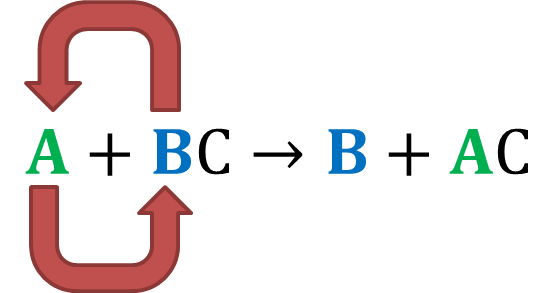
- The completion of the reaction is based upon the reactivity of the elements
If the element is less reactive than the element it is trying to "replace" in the reaction, the reaction will not be completed - Nonmetals replace nonmetals and metals replace metals
- For example:
The Fe (a metal) replaced the Cu (a metal) to create FeSO4


- Follows this structure:
.png?revision=2)
- For example:
 |
| The H2 combines with the O2 to form H2O |
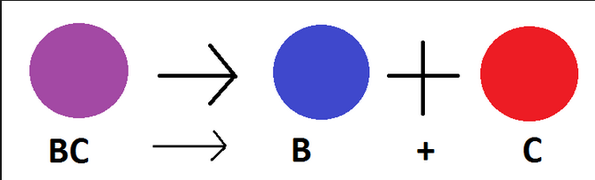
Decomposition:
- Follows this structure:
- For example:
The H2O decomposes into H2 and O2

Bozeman Science Redox Reactions Video
Sunday, November 29, 2015
Acid-Base and Double Replacement Reactions
This unit focuses on chemical reactions, and the chemical reactions that we have learned so far are acid-base and double replacement. Acid-base, obviously deals with reactions with acids and bases that form water and a salt as a product. Double replacement reactions deal with aqueous ionic compounds that form solids as products.
Acid-Base Reactions:
Acid-Base Reactions:
- An acid and a base are placed together, and they react to neutralize the acid and base properties, producing a salt
- A typical acid-base reaction consisting of both a strong acid and a strong base looks like this:
 |
| HCl (a strong acid) combines with NaOH (a strong base) to form water and NaCl. In this reaction, the reactant cations switch to form the products. |
- When the acids are weak, they do not disassociate in the reaction when showing the complete ionic formula of the reaction, but they do give off enough H or OH to react and form water as a product.
- Weak acid+strong base will always have the structure of:
Strong Acid Rules and Examples:
Double Replacement Reactions:

- HCl (hydrochloric acid)
- HBr (hydrobromic acid)
- HI (hydroiodic acid)
- Any acid where oxygens outnumber hydrogens by two or more (ex. HClO4)
Strong Base Rules:
- Cations from group 1 or 2
- All bases have an -OH anion
Common Weak Acids:
- HF (hydrofluoric acid)
- HC2H3O2 (acetic acid)
Crash Course Acid-Base Reaction Video
Double Replacement Reactions:
- Follows this format:
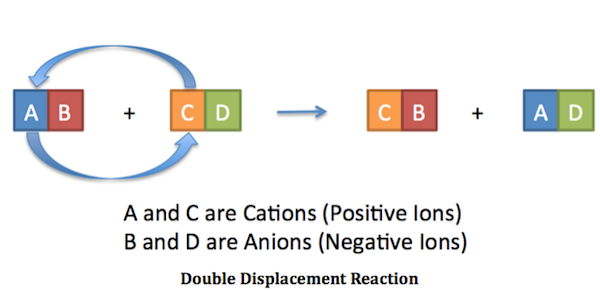
- The driving force is the production of a solid, so if no solid is formed, it is not a completed reaction.
- Can determine if products are solid using solubility rules
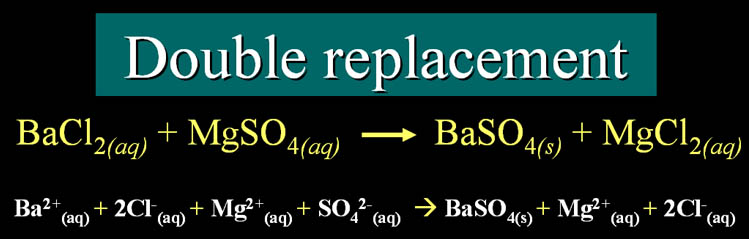 |
| Ba and Mg are the cations, and they switch places to create the products. |
Crash Course Double Replacement Reaction Video
Helpful Links:
Friday, November 20, 2015
Solubility Lab!
This lab was fairly simple, and was interesting to see how accurate the predictions I made last night on the chemical reactions were. We had mix drops of different chemicals together to see which one's reacted or not. The only difficulty in this lab was the time constraint, but my partner, Lindsi, and I managed to finish in time.
 |
| The lab set-up |
 |
| Some of the reactions we saw formed (the colors were really pretty!) |
The (Impossible) Solubility Rules
Last night, I had to memorize the solubility rules for the lab today, and it was awful and hard to memorize at first. I found that it became much easier after doing many practice problems for the lab. This is one of those concepts where I need to memorize and practice a lot before it becomes ingrained into my mind.
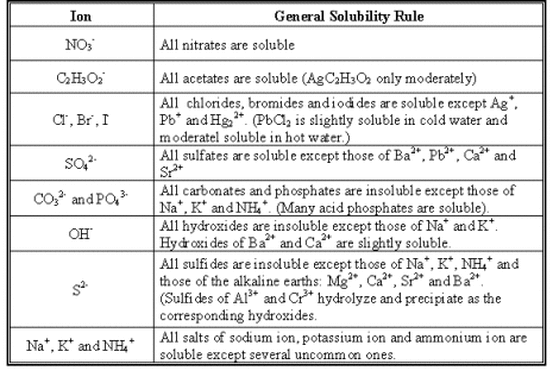 |
| I used this chart because I left my hand-out from Mrs. Frankenberg at home. |
Solubility Rules Mnemonic Device Video
Tuesday, November 17, 2015
New Unit! Balancing Equations
Today marked the first day of the new unit: Chemical Reactions. We did balancing chemical reactions today, and it was mainly review from physical science. It's another math based chemistry unit, but I don't think it will be as heavy handed in math as it was during Chemical Composition.

Steps for balancing combustion equation:
1. Find products (should always be CO2+H2O for combustion reactions)
2. Balance carbon
3. Balance hydrogen
4. Balance oxygen last
5. Reduce all coefficients if necessary
6. NEVER change subscripts for balancing equations

Guide to physical states:
s- solid
l- liquid
g- gaseous
aq- aqueous solution (stuff dissolved into the solution)
Diatomic Elements:
hydrogen H
oxygen O
fluorine F
bromine Br
iodine I
nitrogen N
chlorine Cl
H O F Br I N Cl (Hoffbrinkle)
DON'T FORGET DIATOMICS!!!!!!! THEY ALWAYS APPEAR IN PAIRS!!!!!!
Great website for practice problems:
http://www.sciencegeek.net/Chemistry/taters/EquationBalancing.htm
Diatomic Elements:
hydrogen H
oxygen O
fluorine F
bromine Br
iodine I
nitrogen N
chlorine Cl
H O F Br I N Cl (Hoffbrinkle)
DON'T FORGET DIATOMICS!!!!!!! THEY ALWAYS APPEAR IN PAIRS!!!!!!
Great website for practice problems:
http://www.sciencegeek.net/Chemistry/taters/EquationBalancing.htm
Bozeman Science Balancing Equations Video
Subscribe to:
Posts (Atom)